



Pitiful x PTK continues. Here, Sophie Crocker interviews Brandi Bird about Pitiful, abjection, parasociality, and more. Get pitiful below.
Content warning: emetophobia, discussion of eating disorders.
SC: What’s in your bag?
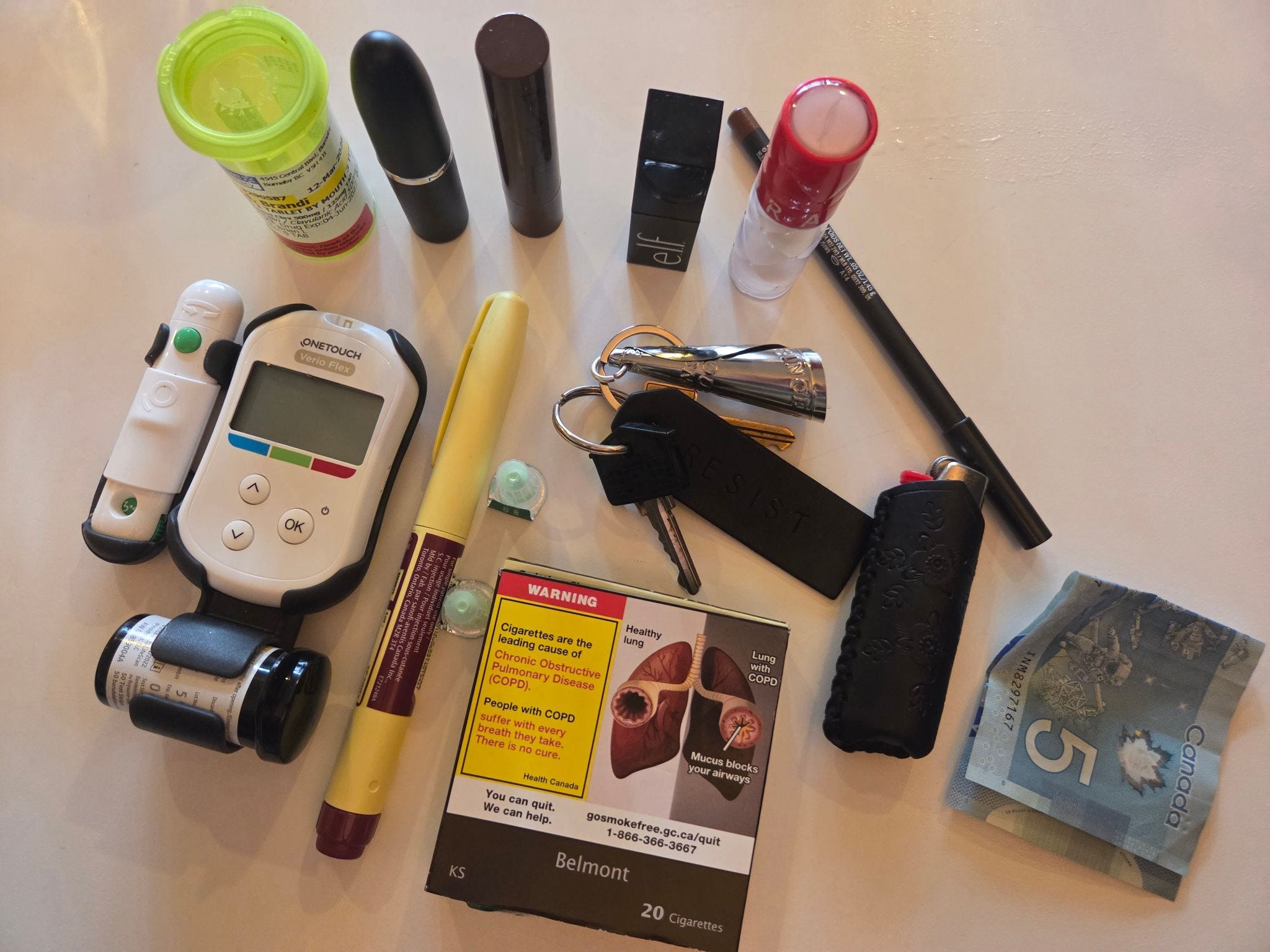
BB: In my black bag shaped like a small horse I named Pal(entine), there is:
Empty bottle of Amoxi-Clav. I just took the last dose of my first course of antibiotics at lunch. I start another course this evening because my face is all messed up and painful from an infection in my jaw triggered by breaking a molar while I was eating granola (well…probably from having anorexia and bulimia for 16 years)
Glucometer because I’m diabetic 🆒️😎
Admelog (rapid acting Insulin pen) and 2 unopened needle caps because my pancreas is dying/dead
Belmonts Kingsized cigarettes (I fully endorse and condone smoking especially if you have a disease that damages your blood vessels)
My keys with a leather keychain that has RESIST engraved in it from Evan Ducharme and a jingle charm from CJ
My bic in a leather holder from Raven’s Veil
5 freaking bucks (best Canadian bill because it has space robots on it)
Mac Lipliner in Cork
Sephora lip plumper in 01 Fever
ELF glossy lip stain in Cinnamon Dreamz
MAC Squirt (????????) Glossy Stick in Lower Cut
Mac lipstick in Iconic Photo
SC: What’s your ideal writing setup?
BB: I don’t have one. I usually write in a journal or on my laptop in unhealthy positions on the couch. Or sometimes I write on my phone in uncomfortable places like the 99 B-Line at rush hour. If I was imagining an ideal writing set up, I’d have a nice lap desk for my comfortable but terribly broken couch. It would have a cup holder and a phone stand built in to it so I could multi-task and it would look suitably modern but cute. Right now, I’m answering these questions wrapped in a fleece blanket from Costco with a bowl of honeycrisp apple slices beside me.
SC: What’s your guilty pleasure?
BB: Anyone who knows me has experienced the intensity of my passions whether they be Paradise Lost or the first responder procedural 9-1-1 (airing on ABC Thursdays at 5PM PST). I’ve always felt an immense amount of shame about my obsessive personality. I spent most of my childhood feeling evil and/or monstrous for what I loved and how I loved them because I was raised in a non-denominational Christian doomsday cult. Everything I loved was either pathologized or was judged as sinful and thus would land me in capital-H Hell (or I’d be Left Behind during The Rapture and then sent to Hell). I’m actively trying to make pleasure something I feel no guilt about. I’ve been unsuccessful so far but I’ve been trying to find joy in how passionate I am by creating safe places to let out all of my obsessions (if you see a 9-1-1 meme aggregate account, that’s definitely not me…).
SC: Where do most of your poems start — a line, an image, a title?
BB: Most of my poems start with an image and then a feeling. Right now, the poems I’m writing have begun with colour. I’ve been inspired by the weird glowing green of text on early computers (one of my mom’s boyfriend’s collected them when I was a kid). These computers were never connected to the internet but I could play solitaire on them and type gibberish on the dusty keyboards and pretend to be hacking the mainframe in The Matrix or whatever. I’ve been remembering the light blue and white of the old LiveJournal communities I frequented. I’ve been feeling sad for my younger self, the kid who watched the blurry rainbow pixelation of the ancient television we had in the living room. I’d secretly watch Queer as Folk and Buffy The Vampire Slayer, sitting up close to the screen with the volume low and my hand on the dial so I could turn it off if I heard a single footstep on the stairwell. All these colours make me feel sad and lonely and then dissociative and that’s where I’m writing from at the moment.
SC: How did you decide on the title Pitiful?
BB: I named the book Pitiful because I thought it was funny. The title came to me after I saw a professor of mine, Sheryda Warrener, on a bus. She saw me struggling to balance a laptop and a bunch of heavy bags on my knees on a crowded bus at rush hour so I could finish an assignment for a creative non-fiction class. She simply said “Brandi, you love to suffer.” I thought that was so funny! That’s absolutely pitiful. That’s Pitiful!
SC: The poems in this collection, in voice and impact, are often anything but pitiful. What role did this apparent contradiction play in putting together the collection?
BB: I wanted to refuse victimhood while speaking about a previous version of myself that desperately wanted to have that status. To me, good, perfect victimhood looked like the white girls I went to treatment with who seemingly had caring families and perfect lives. I know now that no one is ever rescued from themselves regardless of wealth or race. Being rich/middle-class (the same thing to me when I was a kid) or white or having two relatively caring parents does not and did not protect those girls from the world and their own responsibility to act within it. It helps, certainly. But I chose to destroy myself to punish &/or use my body to communicate to people who didn’t notice, care, or (even if they did care) couldn’t ever really stop me. I chose every time and isn’t that kind of wonderful? To have agency in your tragic story?
SC: What role does abjection play in your writing process?
BB: Anxiety and waiting. So much of having an eating disorder is waiting. Waiting to have the time/space to binge and purge. Waiting until 8PM when you can have your one safe meal a day. Waiting on lists for places in treatment centres or hospitals and in ERs and, finally, waiting to die (or more likely, to get older and sadder) as you watch everyone you know fall away from you. Your friends and family grow and move beyond the arrested development the eating disorder locks you in. The abject comes in the fluids of eating disorders, in the liminal body, the loss and gain and loss and gain. It’s in the horror of realising you’ve turned yourself into a porcelain doll, one that ends up forgotten on a dusty shelf in a spare room. The boredom of it all, the boredom that feels like terror and so dangerous. I think writing keeps me away from that feeling and that state, actually.
SC: At times, in your work, parasociality borders on worship. I really relate to this and find it fascinating. the connection to your title might not be intuitive for some readers. How does this parasociality relate to the idea of pitifulness?
BB: Obsession and mimicry. Obsession and poor imitation. Obsession and possession and disgust with yourself and then disgust with the object of your obsession. The push and pull of that cycle is pitiful. It’s absurd and silly and deadly serious too. It’s so many huge feelings and maladaptive reactions to those feelings. It’s a funny joke too.
SC: Our mutual pal/poetry crush Molly Cross-Blanchard ends her collection Exhibitionist with a poem titled “they will call this vulnerable,” which expresses how inadequate and often lazy the term “vulnerable” can be, especially when applied to the work of people of marginalized identities. Instead of vulnerable, what word(s) would you use to describe the process of crafting this collection and putting it out into the world?
BB: I chose what to include and not include in this collection. I need people to remember that. You are being manipulated. You are being narrativized. This is a story of a feeling that only exists in the past for me. Sometimes it was created out of careful lies to build a better story. I’m not being vulnerable. I am making choices with my own artistic agency and my knowledge and awareness of an art I’ve practiced and studied for years. This book is about anti-resilience. It’s inaction and action and consequence either way. It’s dirty and wet and pathetic because I want it that way.
SC: You and I have talked a lot about the idea of breath in poetry. This collection circles the idea of bulimia, which makes me wonder what evacuation means to you, in poetry?
BB: Bulimia for me was more about numbness than evacuation. I physically vomited (a lot), which is a kind of evacuation of course, but it was in service of complete nothingness. In Pitiful, I wanted to play with abstraction and rely less heavily on metaphor (although I still use metaphor quite a lot). I wanted to break some of the poetry “rules” I’ve followed. My poetic practice isn’t cathartic at all. I experience catharsis when I dance or exercise or watch a movie that moves me to tears or laugh so hard I can’t breathe with my friends. Really, Pitiful could only be written once I had no trace of an eating disorder in my life. I have been abstinent from any symptoms for over eight years now, but I’ve tried writing about eating disorders for a long time (nothing came of those half-formed poems and essays). I was too close to see anything meaningful in that part of my life.
You have an extensive understanding of craft in poetry. What advice would you give to an emerging poet?
BB: Learn the poetry “rules” and terms. Don’t stray from those “rules” for the first few years of your practice. Write a lot. Read more. Read the canon and the non-canon. Read widely from different eras and different genres. Keep a notebook if you can. Find someone you trust to edit your work. Know yourself and what kind of feedback you want and at what time (do you want praise to encourage your practice? do you want blunt edits that don’t sugarcoat anything? do you like to revise before sharing your work or do you like to write a draft and throw it into someone else’s hands?). Don’t rush to publish (I did and I regret it).
SC: This was so fun. Love you, BB. Anything else you want to add?
BB: Listen to my playlists, they’re cool and good :)
That’s all for now. Thanks for reading, and thanks, Brandi, for your insights and jokes and thoughts and everything in between.
P.S. Submit to our open call, judged by Zahra Mayeesha. This contest is an excellent opportunities for early-career writers to get their names and words out there. We’d love to read your work!